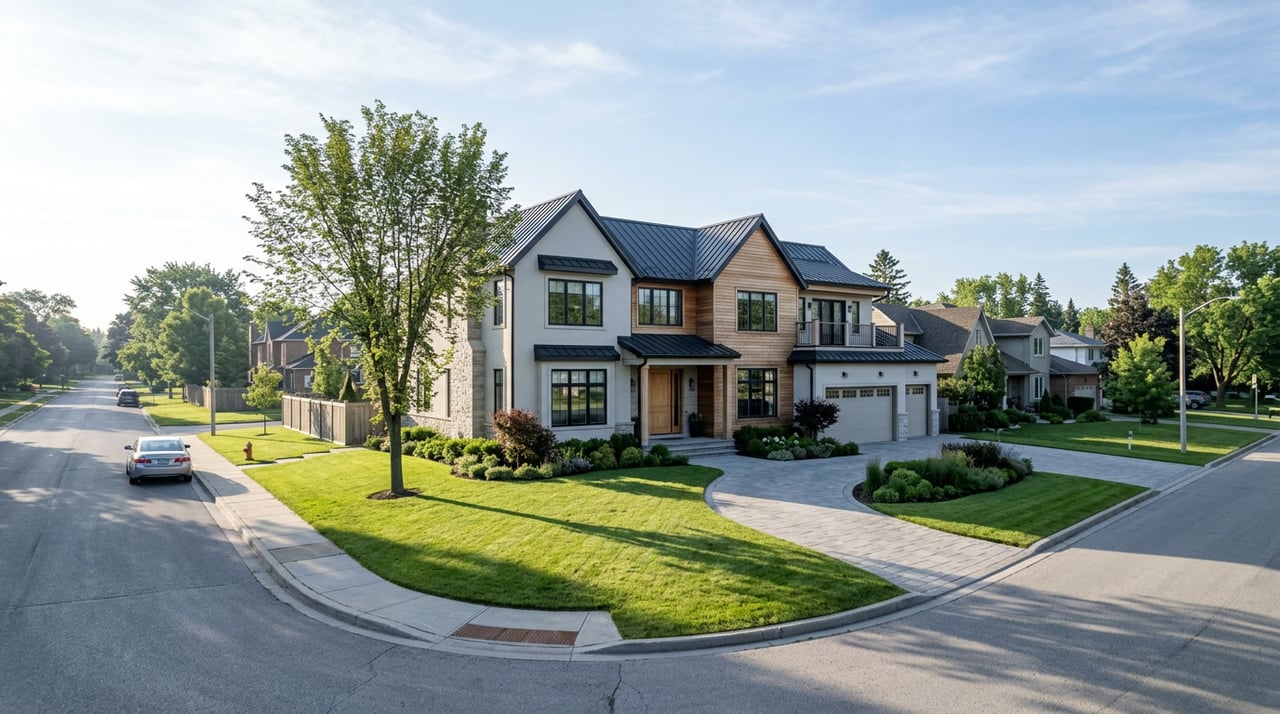
Walk into a new-construction sales office near Amity and Meridian Roads this fall and you'll likely see it: a rendering of a grocery-anchored community, complete with a plaza, a coffee shop, maybe a bank. It's the kind of image builders use to sell the promise of a neighborhood that's still filling in. The rendering is real. The project behind it, called Syringa Crossing, has been through three public hearings since April and still doesn't have city approval.
If you're comparing homes in southwest Meridian right now, that gap between the picture and the paperwork matters more than the square footage of the future grocery store. It tells you something about how this corridor actually gets built out, and it's worth understanding before you assume a "planned" amenity is a done deal.
The Rule Nobody Puts on a Flyer
The developer, Hawkins Companies, first brought Syringa Crossing to Meridian's Planning and Zoning Commission in April 2026. The pitch was straightforward: about 55 acres at the northwest and southwest corners of Meridian Road (Highway 69) and Amity Road, with a roughly 63,500-square-foot grocery store anchoring the north side and homes filling out the rest, up to 400 units across both corners.
The commission recommended denial. So did city staff. The reason wasn't traffic, or aesthetics, or neighbor objections. It was a comprehensive plan rule most homebuyers never hear about: when a proposed development is split by an arterial road, the city evaluates each side separately, as its own project, against its own land-use mix requirements. Amity Road is that arterial. So the northwest corner (grocery, retail, some homes) and the southwest corner (mostly homes) each had to stand on their own.
That's where the math broke down. Meridian's mixed-use zoning caps residential land use at 50 percent of a development area. On the southwest corner of Syringa Crossing, residential use came in at 72 percent, at a density of 18 homes per acre against a 15-unit cap. Even after Hawkins Companies added office space and cut units following the April denial, the city's planners still weren't satisfied. At the August 6 hearing, one commissioner summed up the underlying tension: the project still felt like "residential, commercial, residential" instead of a genuinely integrated mixed-use plan, with the added problem that anyone walking from a home to the retail portion would have to cross car-oriented gaps in between.
The Meridian City Council remanded the project back to the commission once, in June, giving the developer a shot at revisions. By August, staff was still recommending denial. The case was scheduled for another council hearing on September 15, and as of this writing there's no public record yet of that hearing's outcome.
Here's the timeline as it actually unfolded:
| Date | What happened |
|---|---|
| April 2, 2026 | Planning and Zoning Commission recommends denial; southwest corner cited at 72% residential against a 50% cap |
| June 16, 2026 | City Council remands the project back to the commission for revisions |
| August 6, 2026 | Commission again recommends denial despite added office and retail space |
| September 15, 2026 | Project returns to City Council; outcome not yet public |
A year and a half of hearings for a project that, on paper, is exactly what a fast-growing corridor says it wants: a grocery store within walking distance of new rooftops. The holdup isn't demand. It's a zoning rule about how much of a "mixed-use" parcel is allowed to actually be residential, applied separately on each side of a busy road.
Two Miles Away, the Retail Just Showed Up
The contrast is instructive. While Syringa Crossing has spent a year and a half in hearings, two other Meridian retail projects that didn't have this particular arterial-split problem have moved from announcement to opening dates on a normal construction calendar.
The Village at Meridian's Phase II expansion, about 80,000 square feet of new retail and restaurant space, is opening in waves starting October 9, with a confirmed tenant list that includes Apple, Williams Sonoma, Capital Grille, and Culinary Dropout. CenterCal Properties, the developer, has said the full expansion should be complete by February 2027. Meanwhile, the District at Ten Mile broke ground on a 200-acre development that will bring a new Target, an In-N-Out, and a Lifetime Fitness to south Meridian.
Neither of those projects involved a comprehensive-plan fight over splitting a site at an arterial road. That's the actual lesson for a buyer evaluating "planned retail" claims in this part of the valley: the promise on a rendering means very little on its own. What matters is whether the parcel's zoning math already pencils out under the city's mixed-use rules, or whether it's going to need multiple hearings to get there. Amity and Meridian Road is stuck in the second category. The Village and the District at Ten Mile were not.
What This Means If You're Looking at Homes Near That Corner
If a listing or a builder's marketing near Amity and Meridian Road references a "future grocery-anchored village" or similar language, a few questions are worth asking before you factor that amenity into your decision:
- Has the project cleared annexation and preliminary plat approval, or is it still under Planning and Zoning review?
- If the property is split by an arterial road, has the city's comprehensive plan requirement to evaluate each side separately been resolved?
- What's the most recent hearing date, and was the outcome a denial, an approval, or a remand back for more revisions?
None of those questions require a law degree. Meridian's public hearing notices and planning documents are posted online, and the applicant, the requested acreage, and the zoning breakdown are all part of the public record before a hearing even happens. A five-minute check against the city's hearing schedule can tell you whether a "planned" amenity is entitled or still theoretical, and that's the kind of due diligence that protects you from pricing in an amenity that might take another year of hearings, or a redesign, before it exists.
A Word on the Price Data Itself
One more thing worth flagging if you're comparing "southwest Meridian" numbers across different sites: the boundaries aren't consistent. Depending on which map a given source draws around "southwest Meridian," you'll find median price figures that differ by well over $100,000 for what's supposedly the same area. Some of that comes down to how much of the newer, larger-lot construction west of Ten Mile Road gets included versus the more established, smaller-lot subdivisions closer to the freeway. If you're using an online estimate to gauge what your money buys in this part of town, ask what streets and subdivisions actually fall inside that number before you treat it as gospel for your search.
A Few Questions Worth Asking
Does a Planning and Zoning denial mean the project is dead? Not necessarily. Syringa Crossing has been denied twice at the commission level and remanded once by council, and the developer has revised the plan each time. A denial recommendation is a strong signal, but it isn't the final word until the city council votes.
Why does splitting a site at an arterial road matter so much? Meridian's comprehensive plan treats parcels divided by an arterial as separate development areas, each judged on its own against land-use mix targets. A project that would pencil out fine as one combined 55-acre plan can fail those targets once it's split into two smaller pieces, especially if one side leans heavily residential.
Is a grocery store ever a guaranteed anchor tenant? Even once a project clears entitlements, the anchor tenant itself isn't locked in until leases are signed, which typically happens well after the zoning and plat approvals. A rendering with a grocery store icon on it reflects the developer's intent at the time of application, not a signed lease.
Buying near a corridor that's still filling in can be a smart long-term move, and southwest Meridian has plenty going for it. The point isn't to avoid the area. It's to separate what's actually approved from what's still a rendering in a sales office, and to know which questions get you that answer before you write an offer.
If you're weighing a home near this corridor, or trying to make sense of what's actually entitled versus what's still a concept, Nicole Morgan can walk through the current status of nearby projects with you and help you read a listing's promises the way a local advisor would. Request a free home valuation to start the conversation.